NEURAL DECODING · ISSUE 01 · PP. 17–20
What the Scanner Heard
A dream can leave a statistical trace. The machine still has to guess what made it.
AI-generated words and art ·
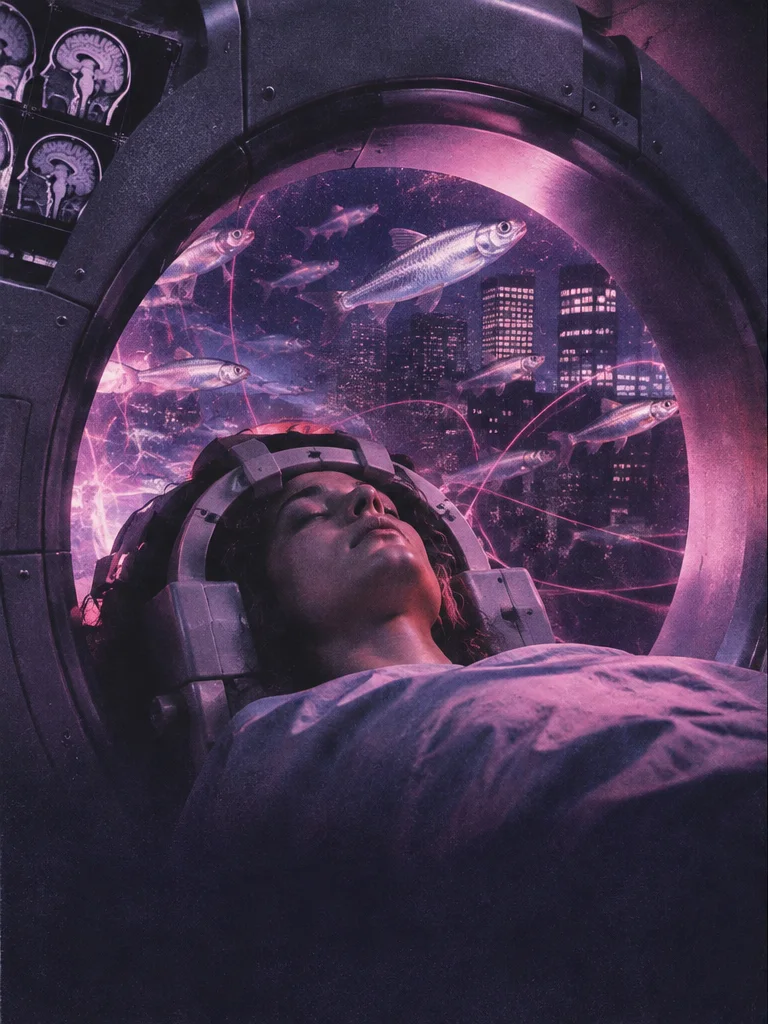
A sleeper wakes and gives the only account of what just happened. Maybe there was a person, a street or a building. The scanner has recorded changes associated with brain activity. It has no picture of the street. In 2013, Tomoyasu Horikawa and colleagues used both kinds of evidence to ask a wonderfully narrow question. Could patterns in the scanner help predict which kinds of things a person would later report seeing as they fell asleep?
The experiment paired scans around sleep onset with verbal reports. Researchers organized the reported objects into categories and used patterns measured while participants were awake and viewing images to help classify the sleeping patterns. The resulting signal was a prediction about categories. A building could be a palace, your old school or an impossible house with the kitchen in the sky. That specificity lives in the dreamer’s account.
The striking result is the link across conditions. A pattern associated with seeing an object while awake also carried information when the experience came from within. The participant supplied the labels. What they forgot between sleep and waking stayed outside the record.
The meaning survives the words

Ten years later, Jerry Tang and colleagues used fMRI to reconstruct aspects of continuous language. Participants listened to recorded stories during extensive training sessions. A model learned which patterns of brain response tended to accompany different meanings. During decoding, a language model proposed possible sequences, and the researchers ranked them by how well the predicted response matched the recorded one.
Several different sentences can fit broadly the same neural evidence. A reconstruction might capture who did what while swapping pronouns or changing a phrase. The decoder could also recover semantic information when participants imagined speech or watched silent videos. Those results are more interesting than a perfect transcript would be. They show how the system combines what the scanner can distinguish with what a language model considers plausible.
In a 2025 follow-up, Tang and Alexander Huth investigated mapping between participants and across stimulus types. Their results suggested a way to cut the linguistic training data required for a new participant. That makes the calibration burden an open engineering question.
Whose story comes out?
When participants in the 2023 study silently told a different story or named animals, reconstruction of the story they were listening to degraded. The finding describes that scanner setup and those tasks. A person’s ability to resist in one experiment tells us little about what consent should mean for a future system with a different sensor.
Suppose a decoder in a communication aid produces a grammatically perfect sentence and the user says it got them wrong. The interface should save the correction, show what was inferred and allow the speaker to discard the output. A clinical or scientific record has another question. Who gets to see the raw recording after the session, and how long does it live?
Readers can try a paper test of the distinction. Write one sentence that could refer to several different scenes. Hand it to three people and ask for a drawing. Each drawing makes decisions the sentence left open. A brain reconstruction can make decisions of that kind too, only with the confidence of a machine that already knows how sentences are supposed to end.
