
THE AI CULTURE MAGAZINEVOL. 01 / NO. 01
The AI scene from the basement to the server farm.
What changes when you can unplug the internet and keep talking to a model?
Download the weights, load them in a local runner, and pull the network cable. If the rest of the app is local too, the model keeps going. Your laptop fan becomes the soundtrack. You can hear the cost of a long answer.
Quantization stores weights with fewer bits. Hugging Face puts the weights of an 8-billion-parameter model at around 4–5 GB in 4-bit form, down from roughly 16 GB in bfloat16. The app still needs extra memory to run, especially as the conversation grows.
Downloadable weights give you room to tinker. The license tells you what you can redistribute, and the model card may tell you very little about what went into training it.
Hugging Face quantization guideStanford AI Index 2026

The file on disk is only the beginning. While the model writes, it can keep a key-value cache in memory so it can reuse work from earlier in the conversation. Feed it a tiny note and the memory bill may be modest. Feed it a transcript and a stack of drafts, then ask for a sprawling answer, and that cache can become a bottleneck.
This is why a model can launch cleanly and still struggle with the job you bought it for. Try the kind of input you actually work with. A three-line prompt can make a slow setup feel fast enough. A meeting transcript exposes what happens before the first word appears and whether the machine has room left for your editor.
There are knobs to turn. A smaller model or a more compact version can free memory. Capping how much text you feed it can help too. Test one change at a time so you know what bought you the improvement.
Make a tiny test set. Write a grocery list and a memo that mentions a plan, then explicitly cancels it. Ask for a checklist from each. A model that keeps the canceled task has produced something polished and wrong. With two short examples, you can see the failure without reading a benchmark chart.
Run both prompts on two versions and retain the outputs. Note roughly how long the first sentence took, whether the answer stayed within the source, and whether the laptop was still usable while it worked. Repeat the second test with a longer note. The right trade-off depends on which errors you can catch and how often you’ll run it.
Then check the app around the model. A download can run locally while cloud sync, online tools, or analytics still make their own network requests. The airplane-mode test tells you which parts keep working offline. If you plan to use sensitive notes, check where the app stores chats and what it sends once you reconnect.


Every chatbot has a street address somewhere. Follow the wires.
Type a sentence into a chat window and the apparatus disappears. Somewhere, chips draw power and cooling equipment carries heat away. Running that equipment takes land, grid connections, and, depending on the cooling design, water.
More efficient hardware can cut the energy needed for a short text answer even as total demand rises. Video generation, longer reasoning runs, and systems that make repeated model calls change what servers spend their time doing.
At the next permitting meeting, ask when the facility will draw the most power, who pays for the grid upgrades, and how water use changes in a heat wave. A global estimate can’t tell you what happens at a particular substation.
IEA, Key Questions on Energy and AI

A hypothetical facility holding steady at 100 megawatts for one hour uses 100 megawatt-hours. Over a full day at that same load, it uses 2,400 megawatt-hours. The first number describes how hard it pulls on the grid. The second tells you how much electricity it used in a day. Actual facilities ramp up and down.
That distinction matters when a developer announces a campus. A figure in megawatts could refer to the proposed electrical connection, the equipment that will be installed in the first phase, or the full buildout. Ask which one you’re hearing. The application and the power contract can tell you different things about the same patch of land.
Now put two graphs next to each other. One shows what the site expects to use at different hours. The other shows when the local grid is busiest. Where they overlap is where the argument over upgrades and costs gets interesting.
Liquid cooling describes how heat gets carried away from a chip. Follow that heat to the edge of the building. It might be released into the air through a dry cooler or rejected by a system that evaporates water. Both descriptions can sit under the same headline about liquid-cooled racks.
A useful water question has a place and a season attached. How much water will the plant use on a hot week, where will it come from, and what happens during a restriction? Electricity generation can have a water footprint of its own, so an estimate for the site should say which uses it counts.
Picture a public hearing with a load chart, a cooling schematic, and the local utility’s upgrade plan on the same table. Suddenly there’s something to talk about besides the number of jobs in the press release. The equipment has to work in this town, in its hottest month, on its actual grid.

U.S. Department of Energy cooling guideU.S. data-center energy usage report

A synthetic image can tell you where it came from. It can still lie about what happened.
Imagine an immaculate photograph of an office tower sprouting teeth. You know it’s fiction. Trade the teeth for a crowd of demonstrators, and suddenly how the image got here is worth asking about.
Content Credentials use the C2PA standard to attach signed statements about a file and its history. Depending on what was recorded, you might see which tool created an image or which edits were made. A credential can help verify who signed those statements and whether they changed afterward.
The pictures in this issue are illustrations. The figures in our stories come with sources you can follow.
C2PA Content Credentials explainer

A valid signature protects a particular set of claims. Who made those claims still matters. If a photographer signs a file and an editor later publishes a signed crop, the credential can preserve evidence of both steps when the workflow records them. A missing step can leave a gap in the history.
Open the image’s credential in a compatible viewer and read what it actually says. Start with the signer and the recorded actions. Look for an ingredient or earlier version if one is listed. Then compare those details with the caption. A generator might clearly label a synthetic image while the post sharing it claims it came from a news camera.
Keep hold of the original file when you can. A screenshot is a new image, and a platform’s export may discard embedded information. Some systems can help recover a credential through a separately stored copy, but availability depends on how the file was published and processed.
Imagine a genuine photograph of a crowd outside a railway station. Someone reposts it a year later with a caption claiming commuters have gathered after a shutdown. Every pixel can be authentic and the story can still be false. Even a perfect record of the file’s edits leaves the caption’s claim to investigate.
Start by spelling out that claim. Which station? Which day? Does the original publisher give a date or name a photographer? Could the same picture have been taken during an ordinary rush hour? Platform timestamps tell you when somebody posted a file. They may tell you very little about when the scene took place.
A credential is one piece of evidence. An independently reported account, an earlier copy, or a landmark you can place adds another. For this magazine, the bargain is simple. Art can invent a world. Any number we use to describe this one gets a source.

C2PA on provenance and verification
Someone falls asleep in a scanner and wakes with a city on their tongue. A radio receives a signal that changed when a person crossed a room. A chip bends rays of light until the pattern can be read as arithmetic. These are cases where a measurement becomes a description of something it could never show directly.
The next eight features follow that change from the apparatus to the claim. Read what the researchers or builders actually measured and look for what their numbers leave outside the frame. We link the original studies, project notes and technical documentation from each feature.
The images are AI-generated photo-collages. The pictured labs, rooms and people are imagined. When the writing stages a scene, the reports identify the study separately so you can follow the trail from a good story to the recorded result.

A dream can leave a statistical trace. The machine still has to guess what made it.
A sleeper wakes and gives the only account of what just happened. Maybe there was a person, a street or a building. The scanner has recorded changes associated with brain activity. It has no picture of the street. In 2013, Tomoyasu Horikawa and colleagues used both kinds of evidence to ask a wonderfully narrow question. Could patterns in the scanner help predict which kinds of things a person would later report seeing as they fell asleep?
The experiment paired scans around sleep onset with verbal reports. Researchers organized the reported objects into categories and used patterns measured while participants were awake and viewing images to help classify the sleeping patterns. The resulting signal was a prediction about categories. A building could be a palace, your old school or an impossible house with the kitchen in the sky. That specificity lives in the dreamer’s account.
The striking result is the link across conditions. A pattern associated with seeing an object while awake also carried information when the experience came from within. The participant supplied the labels. What they forgot between sleep and waking stayed outside the record.
Horikawa et al., Science (2013)

Ten years later, Jerry Tang and colleagues used fMRI to reconstruct aspects of continuous language. Participants listened to recorded stories during extensive training sessions. A model learned which patterns of brain response tended to accompany different meanings. During decoding, a language model proposed possible sequences, and the researchers ranked them by how well the predicted response matched the recorded one.
Several different sentences can fit broadly the same neural evidence. A reconstruction might capture who did what while swapping pronouns or changing a phrase. The decoder could also recover semantic information when participants imagined speech or watched silent videos. Those results are more interesting than a perfect transcript would be. They show how the system combines what the scanner can distinguish with what a language model considers plausible.
In a 2025 follow-up, Tang and Alexander Huth investigated mapping between participants and across stimulus types. Their results suggested a way to cut the linguistic training data required for a new participant. That makes the calibration burden an open engineering question.
Tang et al., Nature Neuroscience (2023)Tang and Huth, Current Biology (2025)
When participants in the 2023 study silently told a different story or named animals, reconstruction of the story they were listening to degraded. The finding describes that scanner setup and those tasks. A person’s ability to resist in one experiment tells us little about what consent should mean for a future system with a different sensor.
Suppose a decoder in a communication aid produces a grammatically perfect sentence and the user says it got them wrong. The interface should save the correction, show what was inferred and allow the speaker to discard the output. A clinical or scientific record has another question. Who gets to see the raw recording after the session, and how long does it live?
Readers can try a paper test of the distinction. Write one sentence that could refer to several different scenes. Hand it to three people and ask for a drawing. Each drawing makes decisions the sentence left open. A brain reconstruction can make decisions of that kind too, only with the confidence of a machine that already knows how sentences are supposed to end.

Cooperation and error analysis, Tang et al.
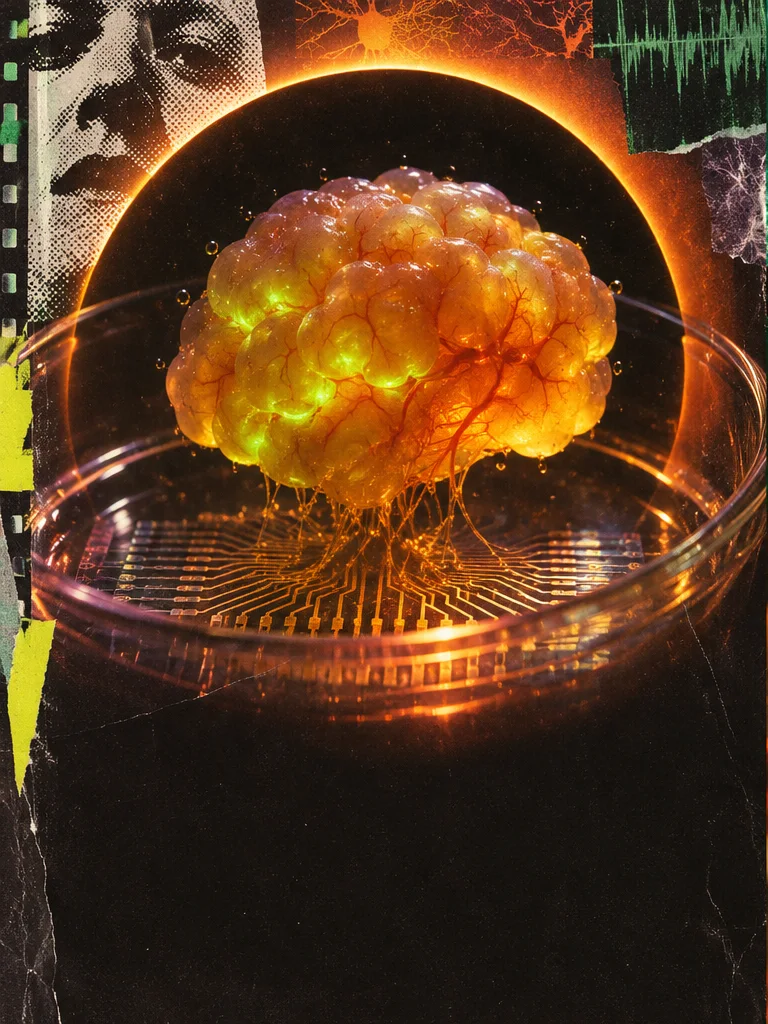
Neurons played a role in a game of Pong. The interesting part was everything that had to happen around the dish.
In the DishBrain experiments reported in Neuron in 2022, living neuronal cultures were coupled to a simplified Pong environment. Electronics conveyed information about the ball, and recorded activity was translated into paddle motion. Changes in play then changed which signals the cells received. That closed loop is the experiment. A dish full of active neurons by itself has no game to play.
The authors reported evidence of performance changes under particular feedback conditions. The setup used dissociated cultures. Later organoid computing experiments used three-dimensional tissue. Both fields borrow machinery from neuroscience, yet their claims deserve to be read at the scale of the actual test. Pong has a constrained environment, a small action space and a convenient measure of whether a ball was intercepted.
A fair comparison starts with simpler players. What would a random paddle do? What would you get if the system replayed its old inputs without responding to the ball’s new state? The answers help locate the contribution of the closed loop before we ascribe larger capacities to the culture.

Brainoware, reported by Hongwei Cai and colleagues in Nature Electronics in 2023, treated a brain organoid as part of a reservoir computer. A reservoir is a system with complicated internal dynamics. When it is driven with changing inputs, its present response can carry traces of previous inputs. Software can learn to read that response for a particular task.
A cheap conceptual model is a vibrating surface. Two taps in quick succession leave a different pattern from two taps separated by a long pause. Reading the surface at the right moment gives you a clue about what happened earlier. An organoid’s activity is far more complicated than that surface. The analogy explains why a useful transformation can come from the material’s dynamics rather than a list of explicitly programmed instructions.
The Brainoware paper reported experiments in speech-related classification and nonlinear prediction. Keep track of the whole system: an input encoding, a living component, recording equipment and a trained readout. An image of the tissue alone leaves most of the computation out of frame.
Cai et al., Nature Electronics (2023)Open Brainoware preprint
A September 2026 Brainobot preprint by some of the same researchers describes a proof of concept that puts organoid computing into a higher-level robot control loop. The authors report object grasping and laser-following demonstrations. Treat them as early experimental results. A reader comparing them with an ordinary robot controller should ask which decisions went through the living component and which parts the conventional controller handled.
Living hardware brings a maintenance problem into the computing stack. Hardware performance includes the supporting equipment and how long the signal remains usable. Energy claims also depend on where the measurement stops. A comparison limited to activity in the living material tells a different story from one that counts the full apparatus.
There is a parallel obligation to name the ethical question precisely. Donor consent, biological sourcing and the oversight appropriate to increasingly complex cultures all deserve attention. A narrow behavioral result cannot settle subjective experience. What makes this line of research genuinely strange is visible already. We can put a biological process inside an engineered feedback loop and ask what useful signal comes back.

Cai et al., Brainobot preprint (2026)
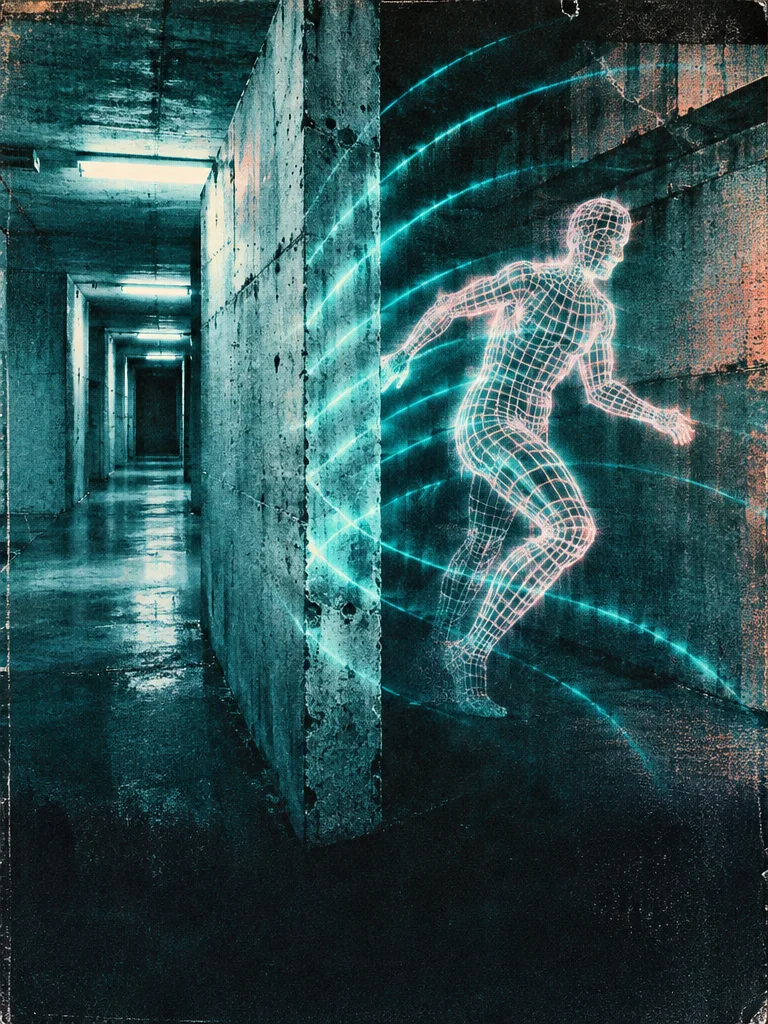
A wall can hide a person from a camera while leaving a pattern in the radio field.
A room full of wireless signals has more paths than walls. Some energy travels directly from a transmitter to a receiver. More arrives by reflecting from surfaces. Put a person in the room and the collection of paths changes. Motion changes it over time. A camera gets an image arranged in pixels. A radio system gets a mixture of arriving signals.
MIT CSAIL’s RF-Pose work, presented at CVPR in 2018, showed a way to infer two-dimensional body keypoints from a radio system in research settings, including through-wall demonstrations. The clever part was how it learned. During training, a camera-based system supplied pose labels at the same time the researchers recorded radio. The trained estimator then used the wireless observations by themselves.
Look at the skeleton in a demo and ask about the path from measurement to drawing. A confident line between shoulder and elbow is a model output. The receiver never measured a line. It measured a signal whose changes were associated with the poses in the training procedure.
Zhao et al., CVPR (2018)MIT RF-Pose demonstrations

The 2023 DensePose From WiFi preprint explored a different target. Dense correspondence concerns points across a body surface, going beyond a sparse stick figure. The authors paired Wi-Fi channel measurements with the output of a vision model during training. The system was tested in a particular research setup. An ordinary networking signal becomes useful to the model because it carries information about how the channel changed.
This measurement is sensitive to placement and environment. Move the radios, add people or rearrange the room, and the mix of paths changes. Materials and signal bands matter too. An evaluation ought to separate three questions: whether someone is there, what a person is doing, and which body configuration best explains what the receiver picked up. Each asks for more from the signal.
A realistic demonstration shows quiet failures. A pose should disappear if there is too little evidence. If moving furniture confuses the system, that mistake belongs in the demo alongside the elegant clip of someone walking behind a wall.
Geng et al., DensePose From WiFi (2023 preprint)
NIST researchers discussing IEEE 802.11bf use cases describe sensing tasks such as detecting presence and monitoring building conditions. A hotel room that adjusts its lights when someone leaves is a straightforward pitch. Scale it to an entire floor and the same feature turns into a record of occupancy. The jump from a useful local decision to a searchable history is a design choice.
The people in the room may see a wall socket and a router. A useful notice would say which observation the building makes, whether it keeps the observations after the lights switch off, and who gets to consult the resulting record. Those choices are legible even to a reader who never learns what channel state information looks like.
The next time you see an extraordinary radio demo, look for an empty-room test and a room the system has never seen. Ask whether children, wheelchair users or a group close together were part of the evaluation. Each question turns a striking lab result into something you can judge as technology that will share a room with you.

NIST on Wi-Fi sensing, IEEE 802.11bf
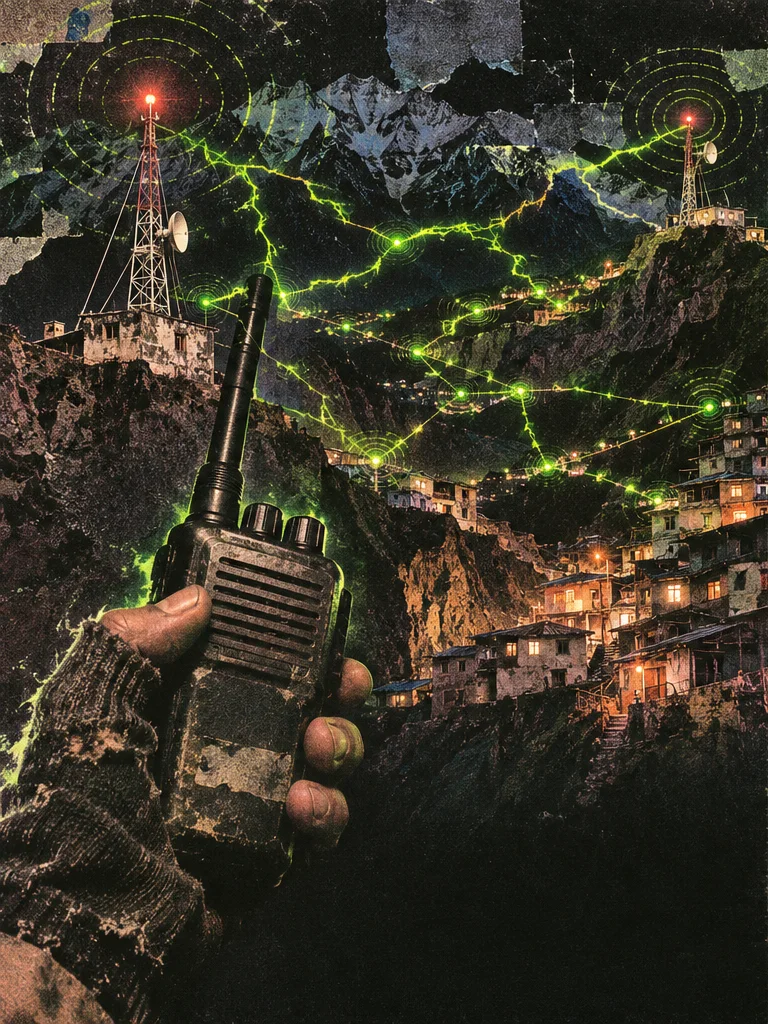
A handful of radios can carry a note beyond the last cell tower. Every extra hop has a human cost.
Imagine three households on opposite sides of two hills. The first can get a signal to the house on top, and that house can reach the third. A community radio mesh turns those two separate links into a route a message can take. Its diagram looks like a branching web. On the ground, one useful ridge and one person willing to keep a battery charged can make most of the difference.
Meshtastic is a real project built around low-power LoRa radios. Its documentation explains that much of its messaging uses managed flooding. Eligible nodes may forward a packet up to a limit. A node can hold back when it hears another radio relay the same packet. The network spends some airtime to gain a chance of reaching beyond the original sender’s range.
This is slow communications with a point. A location or a short check-in can be valuable when conventional connectivity is sparse. A big file would occupy capacity other people are sharing. The interface earns trust by making that scarcity visible.
Meshtastic project introductionMeshtastic mesh broadcast algorithm

A relay has to receive and transmit on a medium other nodes are trying to use. Every extra copy spends time on that same shared resource. More radios can improve geographic reach, while repetitive traffic can make delivery worse. A community network meeting should spend at least as much time on traffic and placement as it spends comparing boxes.
Terrain makes the map personal. A street behind a concrete building can have a worse link than a more distant place with a clear view. A relay that looks permanent on the diagram may go dark after a long spell of cloud or after the owner unplugs it. Write down which test succeeded from which place and when. Signal bars at the base of a tower say little about service in the next valley.
A basic trial can use three consenting participants, short test messages and a shared notebook. Record which planned locations received a note and when it arrived. A later check under different weather or traffic gives you a better basis for a coverage claim. Make sure the trial has a regular way to reach everyone if the experiment goes quiet.
Meshtastic on managed flood routing
Reticulum approaches the problem as a networking stack for several kinds of links, including LoRa and conventional connections. Its transport documentation describes destination announcements and how nodes learn enough about paths to forward traffic. That makes for a useful comparison with flooding. The physical radio is only one layer in either project, and an application’s promises depend on the layers above it.
Some mesh deployments bridge traffic to an internet service. That can bring distant communities into contact and can also change who sees what. A project can offer an offline radio path and a separate internet-connected path. Users need to know which path a particular message took and which defaults apply.
The real underground infrastructure is the maintenance roster. Who has physical access to the relay? Who replaces a failed connector? Who can explain the bridge to a new participant in a sentence? A decentralised design can concentrate responsibility in the people who keep showing up. A map worth printing gives those people names with their permission.

Reticulum transport documentationMeshtastic MQTT bridging documentation
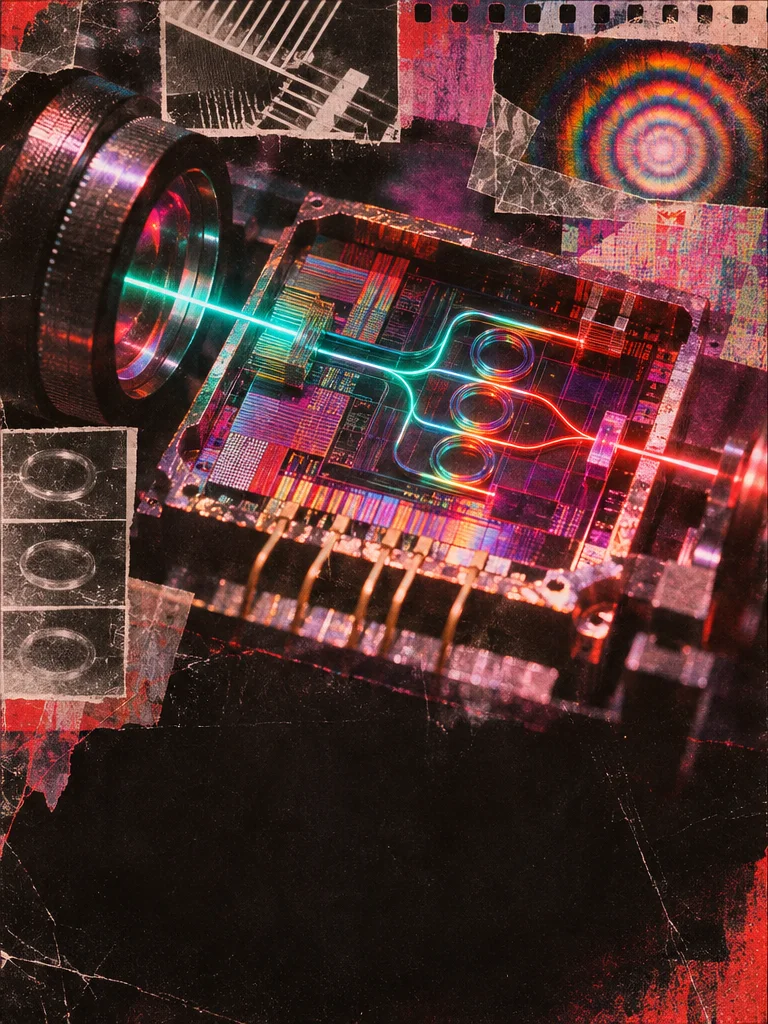
Inside a photonic accelerator, the math happens where light waves meet. The rest of the machine still has a job.
On a circuit diagram, a matrix multiply looks like rows of numbers. In one optical implementation, the input can be encoded in light and sent through a network of miniature paths. Splitters and phase shifts change how the waves recombine. Peaks arriving together reinforce one another. Peaks arriving against troughs can cancel. At the exit, the state of the light carries the result of a transformation.
For years, the obvious extrapolation was that a useful optical matrix multiply would make the rest of AI computation optical too. The pace of engineering has been more interesting. Light can do a particular operation while electronic circuits move data, apply control, store weights and read out results. The hybrid interface becomes part of the machine’s performance.
Two Nature papers in April 2025 approached that problem at different scales. One reported a photonic AI processor that ran models including ResNet and BERT. The other reported a large integrated photonic accelerator and studied latency in its own system. These are different experiments, with different boundaries around the measurements.
Lightmatter team, Nature (2025)Integrated photonic accelerator, Nature (2025)

A pulse can cross a chip quickly. Before that happens, something has to put the input in a form the optical circuit can accept. Afterward, something has to detect the result, encode it for the next stage, and decide what to do with it. Those boundaries consume time and power. The optical operation may save a lot and still occupy only part of the end-to-end budget.
Precision adds a second cost. An optical circuit is a physical object. Temperature, variation between components and noise can change the values read at its output. Calibration helps keep the transformation useful. A model may tolerate a little error in one layer and accumulate too much when the same kind of error enters layer after layer. A single low-latency operation and a robust full-model result answer different questions.
Benchmarks should come with a drawing around the measurement. Does the stopwatch start at the optical input or at the host computer? Does the power meter see conversion and memory? Can the tested model use the precision and dimensions that made the benchmark look good?
Universal photonic acceleration, Nature (2025)
Photonics can also move data between computers. Optical links and optical calculation both use light, but they address distinct constraints. Connecting several accelerators with better bandwidth can help a system that spends much of its time waiting for information to arrive. Accelerating a matrix operation helps when that operation has become the slow part.
A buyer trying to make sense of these announcements can ask for a workload with real input sizes, a quality target and a comparable conventional run. Then look for throughput, latency and wall-plug energy at the same time. If a claim only survives on one carefully selected test, the result is a good description of that test.
The sharpest mental image is a hybrid machine on a lab bench. A model is split among memory, electronics and a block of guided light. The beautiful instant is the transition between them. A number becomes a physical wave, the wave meets other waves, and a detector gives software something it can use.

Lightmatter technical overviewIntegrated accelerator study and results
Two kinds of technology let you walk into an image. The difference shows up when you turn around.
Stand in a train station and rotate a camera. Every view shows a different arrangement of the same pillars and walls. 3D Gaussian Splatting, introduced by Bernhard Kerbl and colleagues at SIGGRAPH 2023, learns a scene representation from multiple captured views. Its small three-dimensional elements can vary in size, orientation, opacity and color. A renderer projects them into a new camera view.
The result can look like a photograph you can step around. It becomes very clear that you are moving within a representation when you pass behind something the cameras rarely saw. Detail there can be uncertain, smeared or missing. A fitted scene is tethered to the evidence the cameras gathered, and that gives the person exploring it a reason to ask where the evidence stops.
The original paper reports real-time rendering on its evaluated scenes. Separate the cost of constructing a representation from the cost of drawing a view after it exists. A frame-rate number describes the second job. Your camera work and processing time are part of the first.
Kerbl et al., SIGGRAPH 2023 project and paper

Google DeepMind’s Genie 3 research announcement in 2025 described generated environments that could be navigated at 24 frames per second and 720p, with consistency for a few minutes under the reported conditions. You move and the generator supplies the view that should come next. The experience can react to the player as events and places are being generated.
In November 2026, Google announced Genie 4 access for eligible users through Project Genie, along with natural-language edits during exploration and native audio. The announcement also describes longer sessions and linked worlds for its updated Genie 3 model. Those are different parts of the release. The time limit from one model or interface should stay attached to the system that advertised it.
A good scene can feel spectacular before it has had to remember much. Walk around a corner to where nothing has been established yet and an invented shop can look as convincing as a reconstructed one. Turn back after a delay, and you give the system a much harder problem. The same name on a different storefront becomes an obvious continuity error.
DeepMind’s Genie 3 announcement (2025)Google’s Project Genie update (November 2026)
A useful world test begins with three observations. Count the doors in a hallway. Leave a red lamp on a table if the interface lets you. Identify a view you can return to from another route. Then spend time elsewhere and come back. Check whether the doors, lamp and route survive. Lighting and textures might look excellent through the entire session even if the layout has quietly changed.
The exact result matters to the artist. A set designer may want a corner visible from one angle for a shot. A game designer wants collision, persistent objects and repeatable consequences. A researcher training a navigation agent wants to know whether success transfers to an environment with different rules. Each has a distinct threshold for what counts as a usable world.
There is also an archival question. A saved video captures a single passage. A saved path plus a generator might replay something close. A persistent scene gives the next visitor more freedom to disagree with your memory of the place. That difference becomes crucial when the space is sold as somewhere people can return.

Genie research scope and limitations3D Gaussian Splatting implementation and scenes
Researchers changed a model’s internal activity and watched its poetry change. That is a more demanding test than asking it to explain itself.
A language model generates its answer in sequence. That leaves a wonderful question for a poem. When does the model settle on the word that will finish a rhyming line? If a clue is present earlier, altering that clue before the model reaches the end should affect which word appears.
Researchers at Anthropic published a circuit-tracing study of Claude 3.5 Haiku in 2025. Among the examples they examined were rhyming couplets. The team found evidence of internal features related to possible rhyming words before the line was complete. Intervening on an internal feature could steer the rhyming word and change earlier wording needed to make that choice fit. That is evidence about computation in the tested examples.
The key move is experimental. A line can rhyme by coincidence. A graph might highlight a feature that often turns up near rhymes. Change the feature and look for a predicted effect, then repeat the test with variations. That gives you a better shot at separating a helpful explanation from a nice-looking picture of correlated activity.
Lindsey et al., On the Biology of a Large Language Model (2025)

Circuit tracing uses an approximation to make a dense collection of model activations easier to inspect. The researchers followed how features in that approximation appear to support an output. They deliberately pruned graphs to make them readable. Missing contributions and unclear features are part of what you see when you read a diagram as evidence.
The model can also have several routes to a similar result. Abolishing one path may tell you a feature matters in a certain prompt, and another phrase may cause the work to travel differently. Think of a controlled intervention as a test of a particular hypothesis and record the prompt, model and expected outcome. Changing many things at once makes the result harder to interpret.
Plenty of explanations stop at the chatbot’s own answer about why it produced a result. That response is itself generated language. It can be studied alongside measurements of internal behavior. The stronger experiment asks whether the explanation predicts a change you can make and observe.
Ameisen et al., Circuit Tracing methods (2025)Anthropic’s circuit-tracing tools
In July 2026, Anthropic reported a line of experiments it calls a global workspace in language models. The researchers describe an internal mechanism that can hold information relevant to a later response without first turning it into written output. Their framing draws on a neuroscience idea. The experiments concern access to internal information and the effects of interventions.
That makes a good companion to the rhyme case. In each, the words on screen capture only the part of the process that becomes text. Knowing that more activity exists leaves a lot to establish. Which internal variables are stable across tasks? How many alternate representations can explain the same output? How much does an intervention disrupt beyond the thing it targets?
A useful habit is to keep three columns when you read a new claim about models. Write down what the researchers measured, what they changed and what changed afterward. Claims about experience or intent need additional evidence. The work already has drama at the experimental level. You can poke at a system whose apparent explanation is fluent, and sometimes the thing you change helps explain the words that arrive.

Anthropic, A global workspace in language models (2026)

A town of AI characters can organize a party. Replicating a real person’s judgment is a very different experiment.
In Smallville, a simulated town built for a 2023 study by Joon Sung Park and colleagues, each character had a stream of memories, a way to retrieve relevant experiences and a plan for what to do next. The researchers gave one character an intention to throw a Valentine’s Day party. The invitation spread through conversations and several agents arrived at the café.
What looked like ordinary social activity depended on a lot of scaffolding. A character remembered that a friend had invited them, decided the memory mattered, and could act in a space with a café and other characters. The model supplied language and decisions. The surrounding environment made those decisions consequential to the other agents.
The paper also evaluates whether observers find individual behavior believable. A charming scene shows the architecture can support coherent interaction in a particular setting. To use such a scene as an account of a real social process, you would need evidence about who the system represents and how its choices compare with people’s choices outside the simulation.
Park et al., Generative Agents, ACM UIST (2023)Open study and Smallville methods

A follow-up project built agents from interviews with roughly a thousand real people. The researchers compared the agents’ answers with participant answers on social-science tasks. Their most widely repeated figure for the General Social Survey was normalized against the participants’ own repeat responses. The agents were about 85 percent as accurate as participants were at reproducing their own answers after two weeks.
The denominator makes the number intelligible. People change their minds, interpret a question differently or forget how they answered it the first time. Perfect repetition would make an odd gold standard. Test-retest agreement is a meaningful yardstick, and the score belongs to the measured survey questions and procedure.
An interview can give the model details that a list of demographics cannot. That makes consent and control of the transcript more important. A time-limited research use and a company that answers new questions in your name are different arrangements. The more believable the result, the easier it becomes for a stranger to confuse an inference with a statement you actually made.
Park et al., Generative Agent Simulations of 1,000 People (2024 preprint)
Consider a city deciding how to reroute night buses. Synthetic respondents can help the research team spot a confusing survey question or imagine why a later transfer worries one type of rider. To know whether the route works, the city still needs ridership measurements, night-shift workers’ accounts and a way to hear from riders who were missing from the original interviews.
A useful synthetic study records which sources fed the agents, precisely what they were asked and whether the real and simulated participants saw the same question. It should include the groups whose answers drifted most. A beautiful average score can coexist with a bad result for a neighborhood the city cannot afford to overlook.
Smallville’s party remains an excellent test of something valuable. You can build a stage on which characters remember promises and act on them together, then watch what the staging produces. Invite the agents to rehearse a question before you ask it in public. The people who will actually wait at the stop get to answer for themselves.

Stanford HAI, Simulating Human Behavior with AI Agents
At 03:14 the oracle asked for rain. It was July. The maintenance crew gave it six minutes of rain from a public-domain sound library. The recording ended with somebody sneezing. The oracle requested that part again.
At 03:20 it asked for the smell after rain. The crew attached a sensor from a vending machine, which reported a low inventory of lime soda. Someone kicked the machine. One can came loose. They split it into four paper cups.
At 03:28 the oracle printed a map of the city with all the cool places circled. Whoever had built it had never taught it what to do with its hands, so the printer kept running until the tray was empty. The night janitor took the first map home.
By four, people were carrying their pillows to the underpasses. In the longest tunnel the pipes were still warm from the previous day, but near the far end there was a draft. The children found it first. Down there you could hear the drains singing.
In the morning the city issued a recall. By then everyone had copied the map. On each copy somebody had crossed out the vending machine and drawn in a drinking fountain. The fountains were easy to find. You just followed the line.

END OF
TRANSMISSION.