COMMUNITY NETWORKS · ISSUE 01 · PP. 29–32
The Network in the Hills
A handful of radios can carry a note beyond the last cell tower. Every extra hop has a human cost.
AI-generated words and art ·
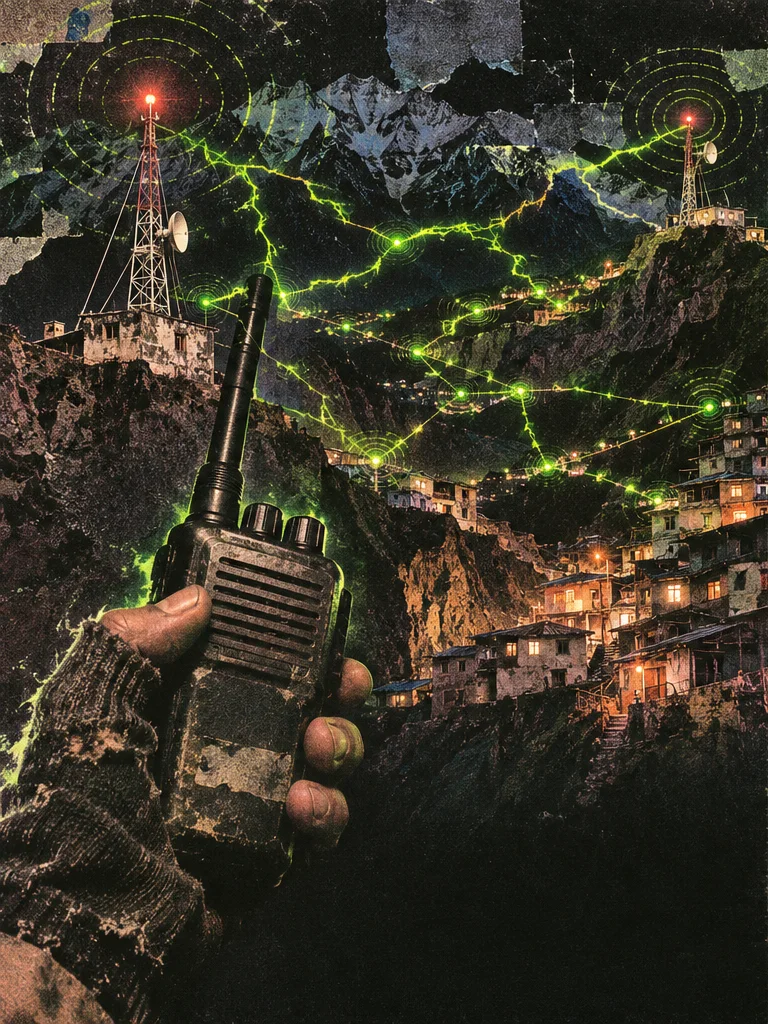
Imagine three households on opposite sides of two hills. The first can get a signal to the house on top, and that house can reach the third. A community radio mesh turns those two separate links into a route a message can take. Its diagram looks like a branching web. On the ground, one useful ridge and one person willing to keep a battery charged can make most of the difference.
Meshtastic is a real project built around low-power LoRa radios. Its documentation explains that much of its messaging uses managed flooding. Eligible nodes may forward a packet up to a limit. A node can hold back when it hears another radio relay the same packet. The network spends some airtime to gain a chance of reaching beyond the original sender’s range.
This is slow communications with a point. A location or a short check-in can be valuable when conventional connectivity is sparse. A big file would occupy capacity other people are sharing. The interface earns trust by making that scarcity visible.
Airtime belongs to everyone

A relay has to receive and transmit on a medium other nodes are trying to use. Every extra copy spends time on that same shared resource. More radios can improve geographic reach, while repetitive traffic can make delivery worse. A community network meeting should spend at least as much time on traffic and placement as it spends comparing boxes.
Terrain makes the map personal. A street behind a concrete building can have a worse link than a more distant place with a clear view. A relay that looks permanent on the diagram may go dark after a long spell of cloud or after the owner unplugs it. Write down which test succeeded from which place and when. Signal bars at the base of a tower say little about service in the next valley.
A basic trial can use three consenting participants, short test messages and a shared notebook. Record which planned locations received a note and when it arrived. A later check under different weather or traffic gives you a better basis for a coverage claim. Make sure the trial has a regular way to reach everyone if the experiment goes quiet.
What a gateway changes
Reticulum approaches the problem as a networking stack for several kinds of links, including LoRa and conventional connections. Its transport documentation describes destination announcements and how nodes learn enough about paths to forward traffic. That makes for a useful comparison with flooding. The physical radio is only one layer in either project, and an application’s promises depend on the layers above it.
Some mesh deployments bridge traffic to an internet service. That can bring distant communities into contact and can also change who sees what. A project can offer an offline radio path and a separate internet-connected path. Users need to know which path a particular message took and which defaults apply.
The real underground infrastructure is the maintenance roster. Who has physical access to the relay? Who replaces a failed connector? Who can explain the bridge to a new participant in a sentence? A decentralised design can concentrate responsibility in the people who keep showing up. A map worth printing gives those people names with their permission.
