NEUROMOTOR INTERFACES · ISSUE 02 · PP. 29–32
The Hand That Barely Moved
A wearable can recover a gesture from electrical activity at the skin. A good interface still has to know when the wearer meant to act.
AI-generated words and art ·
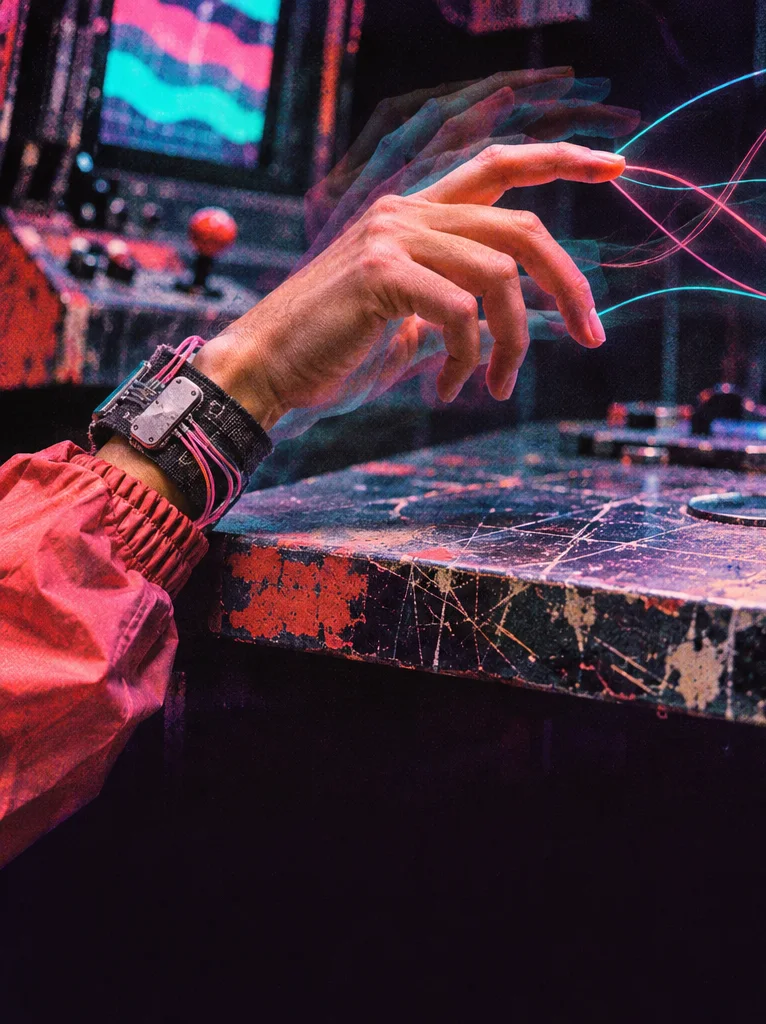
The edge of a person’s thumb moves a fraction. A camera might miss it, particularly if the hand is behind a desk. Surface electromyography records electrical signals on the skin associated with muscle activity. A band whose electrodes make reliable contact can collect a changing pattern even when there is very little visible movement.
In a Nature study published in 2025, researchers at Meta’s Reality Labs trained models for different input tasks using signals recorded at the wrist. They tested continuous cursor-like control, discrete gestures and handwriting. In prompted text-entry trials they reported 20.9 words per minute with the handwriting decoder. That figure comes from an experiment with its own prompts, scoring and equipment.
The result makes a less obvious point about human-computer interaction. Where the body signals a gesture and where a sensor measures it can differ. The user may act at the fingers while the device records at the wrist. Software has to learn which signal changes go with the intended action and which belong to everything else the arm is doing.
Silent speech has a body

A related project moved the sensors elsewhere. In 2018, Arnav Kapur and colleagues at the MIT Media Lab presented AlterEgo, a wearable interface that used neuromuscular signals from the jaw and face during deliberate silent articulation. Its research demonstration explored communication without audible speech. The input was an action a participant practiced while wearing the device.
Put the concepts side by side. A wristband reading a pinch and an interface reading silent articulation rely on signals associated with voluntary motor activity. Neither example requires a camera to see the mouth or hand. The harder work is translating faint signals from particular movements into stable commands and building an interaction that gives the wearer useful feedback.
A user whose signal pattern looks different may need calibration, another band fit or a different gesture. Scope a result by the supported vocabulary, the people included in evaluation and the movements tested. A small set of dependable commands can be genuinely useful when a full free-form interface is still a research problem.
Ordinary motion deserves a vote
A wearable interface should spend at least as much time observing the user not trying to click as it does scoring deliberate clicks. Consider the movements involved in buttoning a coat, carrying a glass or gripping the handle on a bus. The machine needs reliable ways to distinguish a command from the rest of a person’s day.
Set up the comparison with two costs. A missed gesture means repeating an action. A false trigger can send a message or make a change before the intended moment. Some controls should expose a preview or a fast undo. Some should ask for a deliberate second action. Those decisions belong to the interface even if the decoder’s benchmark is excellent.
There is a similarly practical privacy question. A recognized gesture and a continuous record of wrist signals contain different amounts of information. Evaluate the system with a clear account of where raw data goes, when it is stored and whether the user can turn the listener off. A quiet interface can be most useful when the wearer has the clearest idea of when it is listening.
