WORLD MODELS · ISSUE 01 · PP. 37–40
The Door Remembers You
Two kinds of technology let you walk into an image. The difference shows up when you turn around.
AI-generated words and art ·
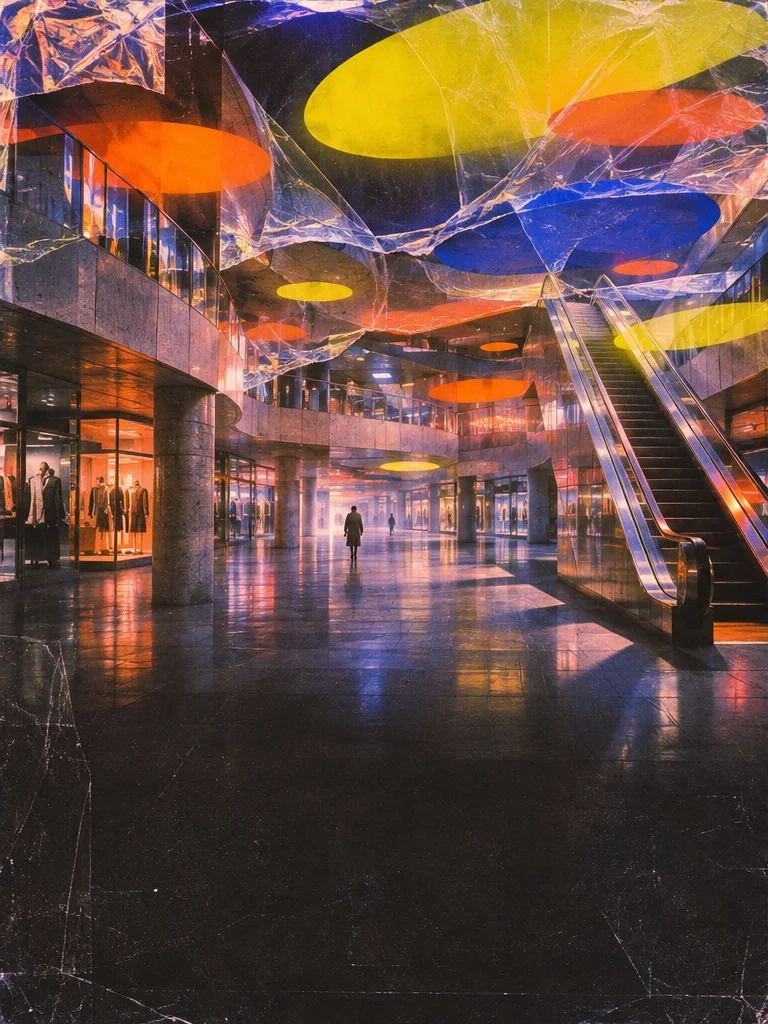
Stand in a train station and rotate a camera. Every view shows a different arrangement of the same pillars and walls. 3D Gaussian Splatting, introduced by Bernhard Kerbl and colleagues at SIGGRAPH 2023, learns a scene representation from multiple captured views. Its small three-dimensional elements can vary in size, orientation, opacity and color. A renderer projects them into a new camera view.
The result can look like a photograph you can step around. It becomes very clear that you are moving within a representation when you pass behind something the cameras rarely saw. Detail there can be uncertain, smeared or missing. A fitted scene is tethered to the evidence the cameras gathered, and that gives the person exploring it a reason to ask where the evidence stops.
The original paper reports real-time rendering on its evaluated scenes. Separate the cost of constructing a representation from the cost of drawing a view after it exists. A frame-rate number describes the second job. Your camera work and processing time are part of the first.
A world made a step ahead

Google DeepMind’s Genie 3 research announcement in 2025 described generated environments that could be navigated at 24 frames per second and 720p, with consistency for a few minutes under the reported conditions. You move and the generator supplies the view that should come next. The experience can react to the player as events and places are being generated.
In November 2026, Google announced Genie 4 access for eligible users through Project Genie, along with natural-language edits during exploration and native audio. The announcement also describes longer sessions and linked worlds for its updated Genie 3 model. Those are different parts of the release. The time limit from one model or interface should stay attached to the system that advertised it.
A good scene can feel spectacular before it has had to remember much. Walk around a corner to where nothing has been established yet and an invented shop can look as convincing as a reconstructed one. Turn back after a delay, and you give the system a much harder problem. The same name on a different storefront becomes an obvious continuity error.
Leave something on the table
A useful world test begins with three observations. Count the doors in a hallway. Leave a red lamp on a table if the interface lets you. Identify a view you can return to from another route. Then spend time elsewhere and come back. Check whether the doors, lamp and route survive. Lighting and textures might look excellent through the entire session even if the layout has quietly changed.
The exact result matters to the artist. A set designer may want a corner visible from one angle for a shot. A game designer wants collision, persistent objects and repeatable consequences. A researcher training a navigation agent wants to know whether success transfers to an environment with different rules. Each has a distinct threshold for what counts as a usable world.
There is also an archival question. A saved video captures a single passage. A saved path plus a generator might replay something close. A persistent scene gives the next visitor more freedom to disagree with your memory of the place. That difference becomes crucial when the space is sold as somewhere people can return.
