INFRASTRUCTURE · ISSUE 01 · PP. 07–10
The Cloud Has a Body
Every chatbot has a street address somewhere. Follow the wires.
AI-generated words and art ·
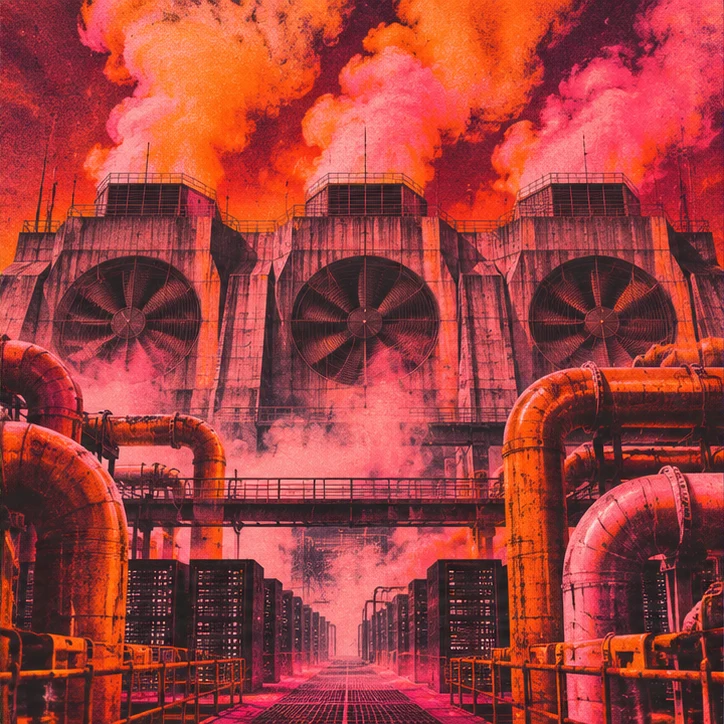
Type a sentence into a chat window and the apparatus disappears. Somewhere, chips draw power and cooling equipment carries heat away. Running that equipment takes land, grid connections, and, depending on the cooling design, water.
More efficient hardware can cut the energy needed for a short text answer even as total demand rises. Video generation, longer reasoning runs, and systems that make repeated model calls change what servers spend their time doing.
At the next permitting meeting, ask when the facility will draw the most power, who pays for the grid upgrades, and how water use changes in a heat wave. A global estimate can’t tell you what happens at a particular substation.
Read the meter

A hypothetical facility holding steady at 100 megawatts for one hour uses 100 megawatt-hours. Over a full day at that same load, it uses 2,400 megawatt-hours. The first number describes how hard it pulls on the grid. The second tells you how much electricity it used in a day. Actual facilities ramp up and down.
That distinction matters when a developer announces a campus. A figure in megawatts could refer to the proposed electrical connection, the equipment that will be installed in the first phase, or the full buildout. Ask which one you’re hearing. The application and the power contract can tell you different things about the same patch of land.
Now put two graphs next to each other. One shows what the site expects to use at different hours. The other shows when the local grid is busiest. Where they overlap is where the argument over upgrades and costs gets interesting.
Follow the heat
Liquid cooling describes how heat gets carried away from a chip. Follow that heat to the edge of the building. It might be released into the air through a dry cooler or rejected by a system that evaporates water. Both descriptions can sit under the same headline about liquid-cooled racks.
A useful water question has a place and a season attached. How much water will the plant use on a hot week, where will it come from, and what happens during a restriction? Electricity generation can have a water footprint of its own, so an estimate for the site should say which uses it counts.
Picture a public hearing with a load chart, a cooling schematic, and the local utility’s upgrade plan on the same table. Suddenly there’s something to talk about besides the number of jobs in the press release. The equipment has to work in this town, in its hottest month, on its actual grid.
