PHOTONIC COMPUTING · ISSUE 01 · PP. 33–36
The Chip That Computes With Light
Inside a photonic accelerator, the math happens where light waves meet. The rest of the machine still has a job.
AI-generated words and art ·
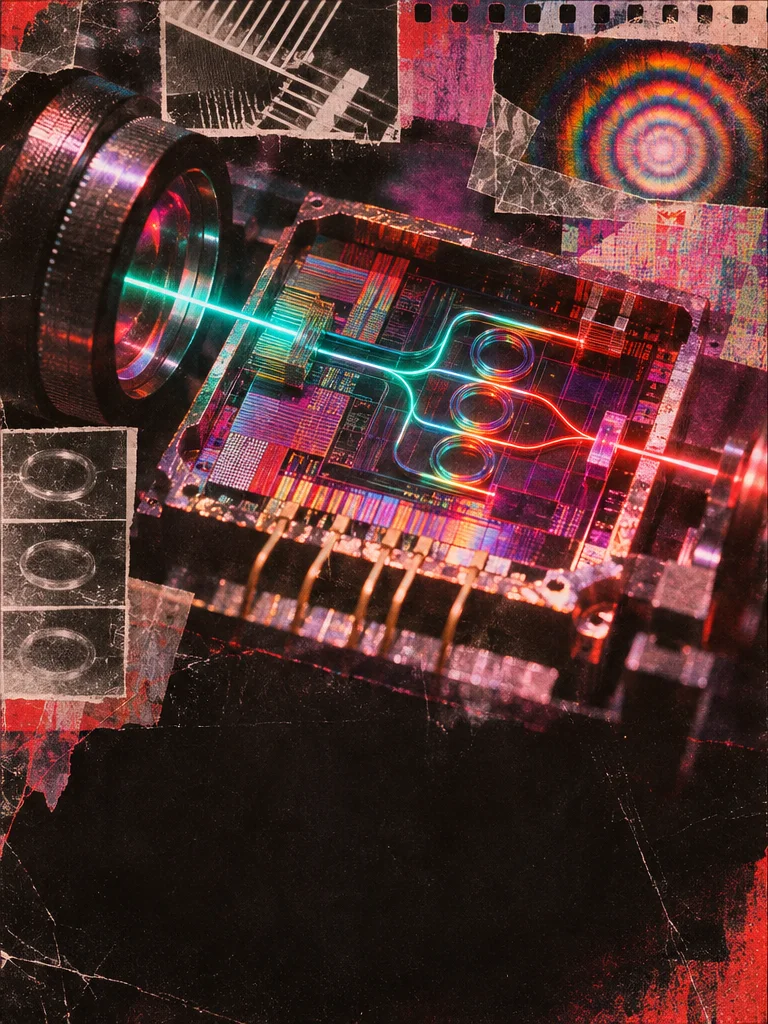
On a circuit diagram, a matrix multiply looks like rows of numbers. In one optical implementation, the input can be encoded in light and sent through a network of miniature paths. Splitters and phase shifts change how the waves recombine. Peaks arriving together reinforce one another. Peaks arriving against troughs can cancel. At the exit, the state of the light carries the result of a transformation.
For years, the obvious extrapolation was that a useful optical matrix multiply would make the rest of AI computation optical too. The pace of engineering has been more interesting. Light can do a particular operation while electronic circuits move data, apply control, store weights and read out results. The hybrid interface becomes part of the machine’s performance.
Two Nature papers in April 2025 approached that problem at different scales. One reported a photonic AI processor that ran models including ResNet and BERT. The other reported a large integrated photonic accelerator and studied latency in its own system. These are different experiments, with different boundaries around the measurements.
The slow parts survive

A pulse can cross a chip quickly. Before that happens, something has to put the input in a form the optical circuit can accept. Afterward, something has to detect the result, encode it for the next stage, and decide what to do with it. Those boundaries consume time and power. The optical operation may save a lot and still occupy only part of the end-to-end budget.
Precision adds a second cost. An optical circuit is a physical object. Temperature, variation between components and noise can change the values read at its output. Calibration helps keep the transformation useful. A model may tolerate a little error in one layer and accumulate too much when the same kind of error enters layer after layer. A single low-latency operation and a robust full-model result answer different questions.
Benchmarks should come with a drawing around the measurement. Does the stopwatch start at the optical input or at the host computer? Does the power meter see conversion and memory? Can the tested model use the precision and dimensions that made the benchmark look good?
A wire is a different kind of win
Photonics can also move data between computers. Optical links and optical calculation both use light, but they address distinct constraints. Connecting several accelerators with better bandwidth can help a system that spends much of its time waiting for information to arrive. Accelerating a matrix operation helps when that operation has become the slow part.
A buyer trying to make sense of these announcements can ask for a workload with real input sizes, a quality target and a comparable conventional run. Then look for throughput, latency and wall-plug energy at the same time. If a claim only survives on one carefully selected test, the result is a good description of that test.
The sharpest mental image is a hybrid machine on a lab bench. A model is split among memory, electronics and a block of guided light. The beautiful instant is the transition between them. A number becomes a physical wave, the wave meets other waves, and a detector gives software something it can use.
