EVENT-BASED VISION · ISSUE 02 · PP. 21–24
The Camera That Only Sees Change
A bicycle wheel becomes a sketch made of timestamps. Ask the sensor what color it was, and you start to understand what the sketch cost.
AI-generated words and art ·
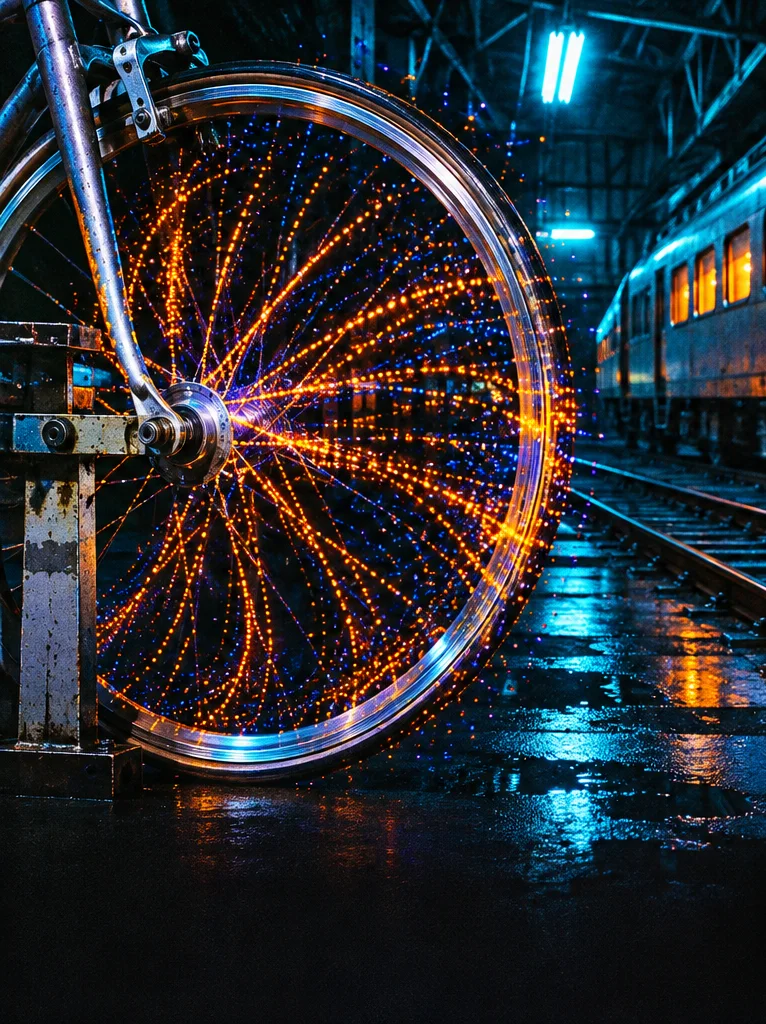
Spin a bicycle wheel under a workshop lamp. A short exposure might freeze the spokes, while a long exposure turns them into a disc. An event camera can report a different thing altogether. Each pixel keeps track of changes to the brightness reaching it. Cross its contrast threshold and the sensor emits an event with a location, time and direction of change.
In work published in 2008, Patrick Lichtsteiner, Christoph Posch and Tobi Delbruck described an asynchronous sensor of this kind. Its pixels responded to relative intensity changes independently. The prototype was small by the standards of a frame camera. Its value lay in the timing of its measurements and the range of light levels across which it could respond.
If a bright spoke swings past a dark patch, the two edges can cause opposite changes at successive moments. Join those events in a time plot and you see a trace of rotation. Stop the wheel and much of the stream goes quiet. The black background in an event visualization can mean that nothing crossed the reporting threshold. The workshop might still be full of light.
The lens has a blind spot

A conventional camera gives a recognition model an entire image on each frame. A stream of dark-to-bright and bright-to-dark changes gives it a kind of conditional sketch. To detect an object, software may accumulate events over some interval, merge them with a conventional image, or carry an internal representation forward as individual events arrive. A longer window can recover more shape and delay a decision at the same time.
Daniel Gehrig and Davide Scaramuzza reported a hybrid system in Nature in 2024. It combined frames with event data to update detections between frames. This put the fast sensor to work where rapid changes offered extra evidence and kept conventional images available for recognition.
A demonstration can feel fast because it shows a scene that benefits from fast updates. A good benchmark declares the frame rate of the comparison, what time counts as the moment the change occurred, and whether the person judging the result sees the missed detections as well as the speediest ones. Sensor response and a useful end-to-end decision deserve separate clocks.
When the stream becomes a flood
A room with fluorescent flicker, textured walls and a moving camera can generate streams of events with very little to do with the object of interest. Sparse measurements are a property of the sensor and the scene together. Light sources, movement and the selected threshold influence how much the computer is asked to process.
A 2026 preprint from Roberto Pellerito and colleagues investigates converting raw events into a learned stream of more informative discrete events. The model learns local patterns and signals when its assigned code changes. Compression here is a decision about which motion and contrast patterns a later task needs to recognize.
The helpful experiment is to count what gets lost. Compare a steady view, a flickering room and a rapid moving object. Look at throughput and detection together. A method that throws away background flicker can earn its keep. A method that throws away the first faint edge of a moving object may give you a visually clean stream and a later warning.
